At EyeHear, we hear the same questions from parents, grandparents and patients of every age. Does reading in the dark ruin your eyes? Can a contact lens get lost behind your eyeball? Will carrots really sharpen your vision? Some of these ideas have a grain of truth.
Most don’t. Here’s what the evidence actually shows, for adults and children alike.
“Reading in dim light damages your eyes”
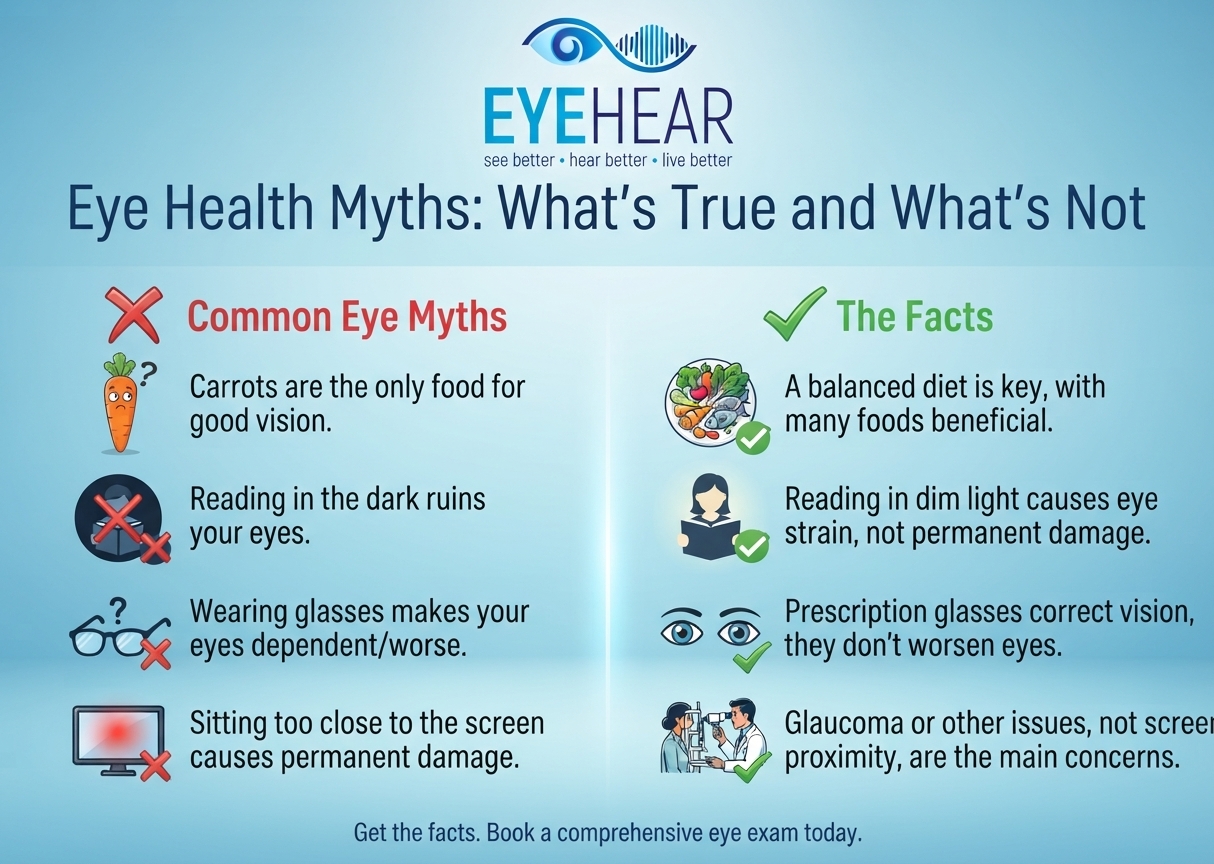
Not true. Dim light makes reading harder, so your eyes work harder to focus. This can bring on a headache or eye strain, but it causes no lasting damage. Your eyes recover as soon as you stop.
“A contact lens can get lost behind your eye”
Not possible. A thin membrane called the conjunctiva covers the white of your eye and lines the inside of your eyelids. This forms a closed pocket. A lens cannot slip behind it, no matter how it feels when a lens moves out of place.
“Wearing someone else’s glasses will damage your eyes”
Not true. The wrong prescription will blur your vision and may give you a headache or double vision. It won’t harm your eyes. One rule matters here: never drive in glasses that are not your own prescription.
“Too much TV damages your eyes”
Not true. Sitting close to the TV or watching in the dark can tire your eyes and bring on a headache. It causes no permanent harm.
There is a related point worth taking seriously, though, especially for parents. Long periods of near work, including reading and screen time, may play a role in childhood myopia developing and progressing. Researchers don’t fully understand the mechanism yet. One theory is that time spent on near work often means less time spent outdoors, and outdoor time appears to protect against myopia. Encourage children to take regular breaks and get outside.
“Eye exercises let you throw away your glasses”
Not true. Most people need glasses because of the shape and size of their eye. No exercise changes that shape. If a product claims otherwise, be sceptical.
“The iris reveals hidden health problems”
Not true, at least not in the way iris-reading practitioners claim. There is no scientific evidence for iridology. What is true is that a full eye examination checks far more than your ability to read a chart. At EyeHear, our examinations look inside the eye for early signs ofconditions such as diabetes and high blood pressure, alongside a full check of your eye health.
“Using your eyes too much wears them out”
Not true. Eye health has nothing to do with how many hours you use them. Your eyes are not a battery running down.
“Holding a book too close will damage a child’s eyes”
Not true. How a child holds a book has no effect on eye health, and it doesn’t automatically mean they need glasses. Children often have excellent focusing ability at close range, so reading close-up simply feels comfortable to them. There is one thing worth watching, though. If a child sits very close to the television, this can signal difficulty seeing at a distance. Book them in with us to check.
And the same near-work point applies here too: extended close-up work may contribute to myopia developing and progressing in children, likely linked to reduced time outdoors.
“Carrots improve your eyesight”
Partly true. Carrots contain vitamin A, which supports eye health as part of a balanced diet. Poor nutrition has been linked to conditions such as age-related macular degeneration. Carrots won’t sharpen your vision beyond normal, but good nutrition genuinely matters for long-term eye health, at every age.
The bottom line
Most eye myths trace back to genuine discomfort, a headache, tired eyes, or blurred vision, mistaken for lasting damage. The one pattern backed by real evidence is the link between extended near work, reduced outdoor time, and childhood myopia. Whether you’re bringing in a child for their first check or booking your own routine examination, the team at EyeHear is here to give you answers grounded in fact, not myth. Book an eye examination with us today.